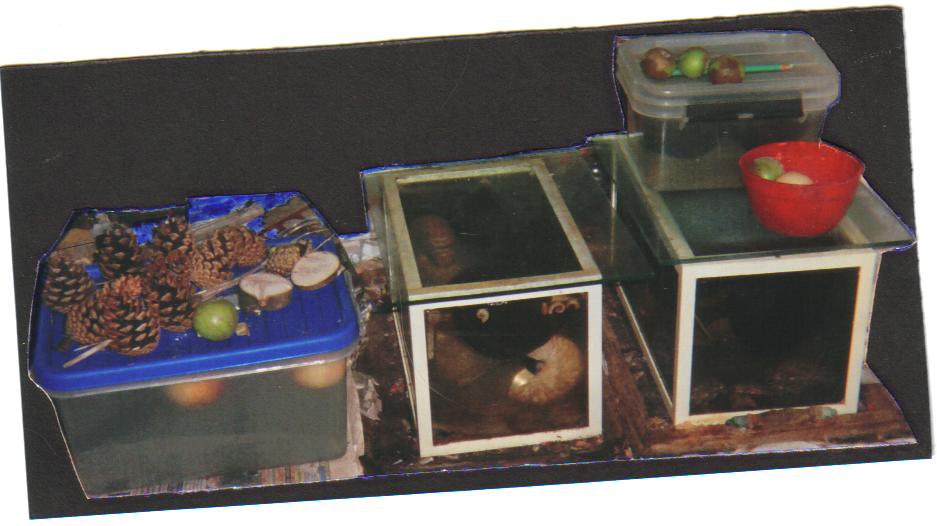
Coconut I of my experimental floatations in seawater was marketed, wrapped in plastic, as a “Milky Coconut, Dominican Republic 5711/03 class 1, display until February 8 2005”. The initial mass, inclusive of subsequently removed plastic and coir fibres was 605 g and sank in seawater in February 1 2005 at 15.30 hrs G.M.T. During the first two and a quarter hours air bubbles effused from around two of the three eyes (basal pores) when the coconut was manually inverted from the usual apex-up orientation when sinking. This air presumably came from the nut wall, via canals seen radiating from the inside of the basal pores on split specimens, since the nut exterior changed from light to dark brown in this short time. A wet mass, exclusive of removed coir fibres and plastic was recorded as 607 g after exactly 2.3 of a day in the seawater tank, rising to 611 g on days 2.6 and 11.8. After this the coconut was removed to the bottom of an open bucket used to house the rejected old tank seawater and had a mass of 607 g on day 100, 601 g on day 127 and 598 g on day 200. This water sometimes had a raised density due to evaporation before being exchanged with new water from the sea and this was 1.032 g/ml on day 575 when coconut finally had lost enough internal mass of endosperm and or milky liquid to resurface. It was then returned to the diurnally aerated tank seawater of 1.029 g/ml density where it promptly sank at a mass around 586 g. The displacement volume found by dividing this mass by the density of the two seawaters was therefore 567 to 568 ml, and the initial density when marketed 1.06 g/ml. The cited water densities are from a hydrometer only giving an exact reading at 20°C and actually recorded at 6 hrs G.M.T. on August 31 2006 at 16°C. The air temperature above the bucket had risen to above 77°F (25°C) in the later July 2006 heatwave without causing the coconut to resurface. This suggests that expansion of primary and secondary decay gases by increased ambient temperature is not the direct cause of resurfacing during a relatively cool weather. Probably the high temperatures increased the rate at which the milky liquid and endosperm inside the nut was converted into gas, but due to the still intact nature of the three basal pores and nut wall the gases merely diffused out if their partial pressures were greatly in excess of the ambient and similarly stagnate seawater. In previous experiments, reported from the fresher tank seawater in my articles in
The Drifting Seed (2005, 2006) the initially more buoyant coconuts A to F all became gradually less dense during the first 200days of flotation and only then started to gain mass due to a net replacement of their internal primary and secondary gases by seawater. Coconut I is merely following the same trend but on a longer time-scale and with little or no primary air present inside the endosperm cavity when marketed. Some of these coconuts contained little or no milky liquid when marketed and evidence of loss of endosperm flesh under the basal pores before the latter became thin or open enough to admit seawater at an increasing rate in the aerated tank environment. Probably there is a similar decay of endosperm flesh into bacteria plus gas going on to reduce the mass of coconut I, and not merely fermentation of milky liquid which may have actually slowed the decay process in the denser endosperm down? It is predicted that coconut I, now kept in the aerated tank environment will soon resurface due to further internal mass loss.
My tanks.