October 10 2006. The highest predicted tide at Chalkwell, not only this year but for several others, was yesterday afternoon at 3.4 m above mean sea level, and both tides on the 8th and the 13.35 G.M.T. tide today were predicted as 3.3 m. Presumably this is due to the unusual size and yellow appearance of the Harvest moon, which was so impressive at the end of last week. Also a quarter of an inch of rain fell locally on October 5. This resulting flash flood and high tides evidently a gravel ridge, capped with rolls of algae concentrated on the west sides of breakwaters, before the highest predicted tide arrived. This ridge did not look much different this morning. It had just gathered more algae, plus a new element, Sea Purslane leaves removed from upper beaches and marches by high tides. It was more instructive to observe much the same floating materials in today’s high tide before it could amalgamate them with less buoyant and older stranded material on the beach. The material actually seen coming in floating with the tide over a studied distance of 1.7 km were two brown oak leaves, 15 conspicuous feathers (mainly gulls up to 320 mm length, but including two of the banded ?Curlew feathers discussed previously of 225 mm length); large rafts of Sea Purslane leaves (Halimione portula coides (L.), which floated for 48.2 days when picked and tested in December 2000) and sea grass (Zosteras),this became more common towards Westcliff than the Sea Purslane presumably coming from Leigh March rather than intertidal sands); much large human wood debris evidently coming from a flooded café selling cockels, but perhaps not directly and a floating building stone discussed below and a few plastic bottles and drink cans. In addition there were a few floating sticks.
Below this level in the sea was a swash zone of non-buoyant material being suspended by the waves and moved on to the beach above even less buoyant strandline material such as stones and open bivalve shells (Mytilus x Mercenaria). The suspended material included one large and one small dead Common Crab (Carcirus), brown algae and other vegetation bound into rolls along the edge of the incoming tide, one or two brown leaves of genera other than oak, a cone of Pinus nigra and a cultivated apple. Neither of these floated when taken home and tested in more static seawater, although they appeared to do so due to the motion of the waves. Apples but not pine cones were also conspicuous on the gravel ridge made recently, as was the building stone debris. They are therefore reviewed here.
At first sight one assumes the brown and deplorable state of the apple is due to the work of the sea, and seabirds, while it was gradually becoming non-buoyant on the intertidal mudflats. However, both the pitting and brown to black external colouration matches an apple of the same size and shape picked from the wet soil inland today. They even turned brown when kept dry and away from Magpies, after a few days indoors; while these placed directly in seawater look unaltered and can float well (as do the brown previously decayed type). The drifted apple had an equatorial diameter of 55 mm and a height diameter of 42mm, on a short stalk. One side was black and crushed, and corresponded to the bruised zone caused by landing inland. Stranding in the swash before collection produced radial cracks, which lost air when refloated. The only significant differences between the two brown and pecked apples were seen after cutting in half. The stranded one had flesh of the same orange colour, which was firmer and non-buoyant in seawater, and the core lacked seeds. It was not clear why the seeds were missing although insect borings along the stem might have been missed in such a decayed structure. Clearly the stranded apple was a red to yellow variety of Malus domestica Borkhausen which is unlikely to have been sold to the English public in that state and probably came from rejected garden waste, or in a flash flood (they do float in tap water for over a day even when brown and from wet soil). Obviously the many apples seen on Southend beaches earlier in the year have just been rejected from lunch boxes, being out of season and quite undecayed. Tested Crab Apples float much less well and probably cannot reach the sea in rivers at all (see also photographs taken October 7th).
Thursday, November 02, 2006


Coconuts and Pinecones
October 8 2006.
coconuts and pinecones
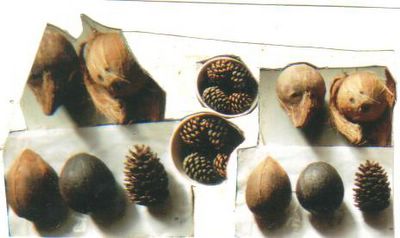
A second pair of photographs taken yesterday shows dried pinecones and coconuts at slightly different angles and illuminations. The bowl shows Pinus nigra cones dried-out after having sunk recently. The greater size of the now fully dry pinecone stranded at Chalkwell on April 7 2006 is illustrated by placing it beside them on the bottom left hand side of the four coconuts. Probably it is Pinus pinaster Aiton, with the apical scales fibrous and partly missing by the combined effects of maturation on the tree and beach erosion, prior to the final episode of marine transport from an unknown (English?) beach. Two of the coconuts also stranded in the Southend-on-Sea area, probably after being released into London canals for Hindu Rituals. The one on the top left stranded at Thorpe Bay during a S.W. gale at 16 hours. G.M.T. on January 13 2004, and shows a triangular mass of coir fibres truncated into a 10 mm diameter facet by Man rather than a natural erosive process in the Gulf Stream. It was then floated in the illustrated bucket, without drying during collection or major weight gains until it was removed on July 12 2006. During this time in the bucket the mass decreased from a maximum of about 806 g to about 673 g, and the orientation changed from coir-apex down to horizontal, presumably because the endosperm white flesh of the coconut gradually decayed. Certainly it now rattles about in this new even less dense dry state. One of the eyes was open enough for air bubbles to exit it when collected. An old water line in the bucket experiment can be hopefully seen on the photograph defined by a white band with a chord diameter of 80 mm on the opposite end of the nut from the coir fibres around the eyes. The overall length is 170 mm and the equatorial diameter 110 mm.
The stranded coconut on the top right is the one discussed on this blog and was found near Chalkwell Shelter on April 2 2006, with the husk separated and one of the eyes which had been covered by it seen to have a tunnel of white endosperm below it. In this case the husk looks more extensive than that seen usually on sale in England.; but might presumably have been imported for a Hindu niche market. I wish I knew exactly how Hindu’s prepare their coconuts for ritual refloatations and when. The usually cited and observed canal and coastal rituals are roughly in August and not when I see strandings at Southend. Natural drifting with the Gulf Stream is possible but would seem likely to produce more evidence of marine encrustation. Illustrations of stranded coconuts at intermediate sites would be instructive if they show what form the husk has after being floated by hurricanes etc.
The two lower coconuts were purchased from an English supermarket, where they are sold with less husk present than in some Green grocers shops. They are coconuts A (left) and B (right) of my notes in The Drifted Seed 2005 and 2006. The photograph is mainly of interest in showing that coconut B has become black during a second summer of drying after having sunk in seawater. The other coconut A shows the colouration after drying for just one summer and when any coconut has been in seawater for a day or so it is dark brown. In terms of mass changes in coconut B, there was an increase from about 550 g when purchases., to 620 g just after it sank and 644 g when drying started on day 626 of the experiment. Dehydration and perhaps some decay reduced the mass to 339 g on day 802; but after the nut became black again and leaked green copra oil from the eye the mass was further reduced to 259 g on day 1100 (which was just prior to the photography). Curiously when half-coconuts are left exposed to the air and not eaten by birds the flesh seems relatively stable at English temperatures.

coconuts and pinecones

A second pair of photographs taken yesterday shows dried pinecones and coconuts at slightly different angles and illuminations. The bowl shows Pinus nigra cones dried-out after having sunk recently. The greater size of the now fully dry pinecone stranded at Chalkwell on April 7 2006 is illustrated by placing it beside them on the bottom left hand side of the four coconuts. Probably it is Pinus pinaster Aiton, with the apical scales fibrous and partly missing by the combined effects of maturation on the tree and beach erosion, prior to the final episode of marine transport from an unknown (English?) beach. Two of the coconuts also stranded in the Southend-on-Sea area, probably after being released into London canals for Hindu Rituals. The one on the top left stranded at Thorpe Bay during a S.W. gale at 16 hours. G.M.T. on January 13 2004, and shows a triangular mass of coir fibres truncated into a 10 mm diameter facet by Man rather than a natural erosive process in the Gulf Stream. It was then floated in the illustrated bucket, without drying during collection or major weight gains until it was removed on July 12 2006. During this time in the bucket the mass decreased from a maximum of about 806 g to about 673 g, and the orientation changed from coir-apex down to horizontal, presumably because the endosperm white flesh of the coconut gradually decayed. Certainly it now rattles about in this new even less dense dry state. One of the eyes was open enough for air bubbles to exit it when collected. An old water line in the bucket experiment can be hopefully seen on the photograph defined by a white band with a chord diameter of 80 mm on the opposite end of the nut from the coir fibres around the eyes. The overall length is 170 mm and the equatorial diameter 110 mm.
The stranded coconut on the top right is the one discussed on this blog and was found near Chalkwell Shelter on April 2 2006, with the husk separated and one of the eyes which had been covered by it seen to have a tunnel of white endosperm below it. In this case the husk looks more extensive than that seen usually on sale in England.; but might presumably have been imported for a Hindu niche market. I wish I knew exactly how Hindu’s prepare their coconuts for ritual refloatations and when. The usually cited and observed canal and coastal rituals are roughly in August and not when I see strandings at Southend. Natural drifting with the Gulf Stream is possible but would seem likely to produce more evidence of marine encrustation. Illustrations of stranded coconuts at intermediate sites would be instructive if they show what form the husk has after being floated by hurricanes etc.
The two lower coconuts were purchased from an English supermarket, where they are sold with less husk present than in some Green grocers shops. They are coconuts A (left) and B (right) of my notes in The Drifted Seed 2005 and 2006. The photograph is mainly of interest in showing that coconut B has become black during a second summer of drying after having sunk in seawater. The other coconut A shows the colouration after drying for just one summer and when any coconut has been in seawater for a day or so it is dark brown. In terms of mass changes in coconut B, there was an increase from about 550 g when purchases., to 620 g just after it sank and 644 g when drying started on day 626 of the experiment. Dehydration and perhaps some decay reduced the mass to 339 g on day 802; but after the nut became black again and leaked green copra oil from the eye the mass was further reduced to 259 g on day 1100 (which was just prior to the photography). Curiously when half-coconuts are left exposed to the air and not eaten by birds the flesh seems relatively stable at English temperatures.
Subscribe to:
Posts (Atom)